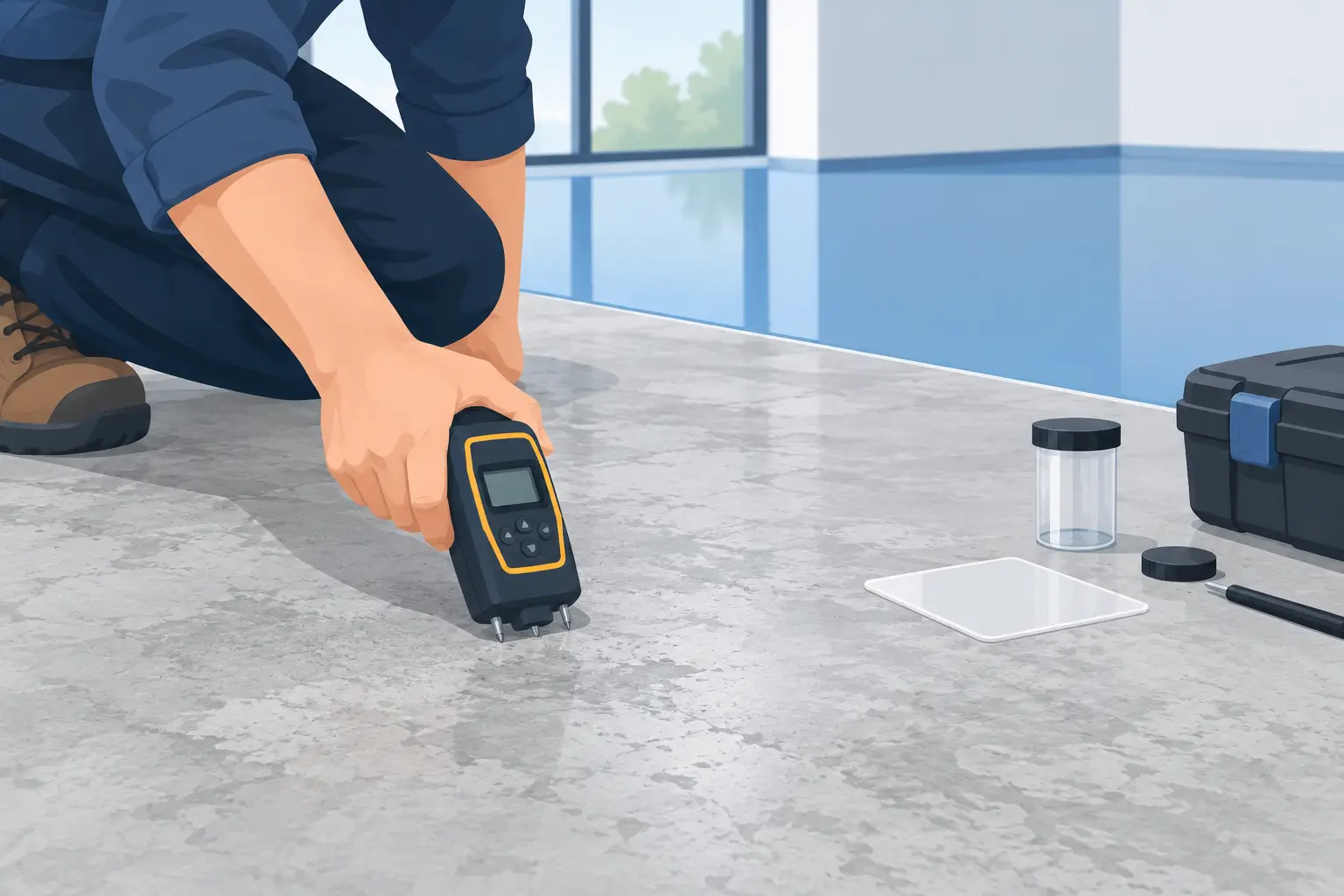
A garage floor can look dry, feel hard, and still hold enough moisture to push an epoxy coating loose months later. Knowing how to evaluate slab moisture before coating work is one of the best ways to avoid peeling, bubbling, whitening, and expensive do-overs. Moisture testing is not a box to check after the color is chosen. It is part of deciding whether the concrete is ready, what preparation it needs, and whether a moisture barrier belongs in the system.
Why slab moisture matters before epoxy
Concrete is porous. Water vapor can move through a slab from the soil below, from residual construction moisture, or from damp conditions around the building. When that vapor reaches the surface, it can create pressure beneath a coating. Epoxy is durable, but it is not a fix for a slab that is releasing more moisture than the coating system can handle.
The results may not show up on day one. A floor can look great at installation, then develop blisters, delamination, discoloration, or soft spots after seasonal humidity changes. Basements, older garages, ground-level retail spaces, workshops, and slabs without a reliable vapor barrier deserve special attention.
Surface preparation still matters. Grinding removes weak concrete, old coatings, contaminants, and surface laitance so the coating can bond to sound concrete. But even a properly ground floor needs moisture conditions that fit the coating manufacturer’s requirements.
Start with the slab’s history and visible conditions
Before selecting a test, look at the slab and ask practical questions. Has the floor ever had water intrusion? Does the area sit below grade? Are there gutters, downspouts, landscaping, or exterior grading that direct water toward the building? Has moisture appeared after heavy rain, snowmelt, or a long humid spell?
Visible clues can point to a problem, but they do not replace testing. Watch for darkened areas, white mineral deposits called efflorescence, rusted items sitting on the floor, damp perimeter edges, peeling paint, or old adhesive that has turned soft. A musty odor in a basement or recurring condensation can also signal conditions worth investigating.
Age matters, too. A newer slab may still be drying from construction, while an older slab may have a missing or deteriorated vapor barrier below it. Never assume that a decades-old floor is dry simply because it has been covered with carpet, tile, paint, or a previous coating.
How to evaluate slab moisture with the right tests
A dependable evaluation uses a recognized moisture test and follows the coating manufacturer’s limits. The right method depends on the project, the concrete condition, the coating system, and the level of risk involved.
In-situ relative humidity testing
In-situ relative humidity, often called RH testing, measures humidity inside the concrete slab rather than only at its surface. Test holes are drilled to the required depth, probes are placed in the slab, and the readings are allowed to stabilize according to the test procedure.
This method gives a useful picture of moisture deeper in the concrete, where future vapor movement originates. It is especially valuable for commercial floors, larger installations, and slabs where a long-term coating performance decision is on the line. RH testing is commonly performed under ASTM F2170 procedures.
The number that passes or fails is not universal. One coating may allow a higher RH reading than another, and some systems require a moisture-mitigating primer once a certain threshold is reached. The product data sheet for the exact primer and epoxy system should set the limit.
Calcium chloride testing
Calcium chloride testing measures moisture vapor emission rate, or MVER, from the slab surface over a defined test period. A prepared test area receives a dish of calcium chloride beneath a sealed cover. The change in the material’s weight helps calculate how much moisture vapor is leaving the concrete.
This test, commonly associated with ASTM F1869, can be useful when specified for the coating system. It measures emissions at the surface, not internal humidity, so it does not tell the whole story in every situation. Still, it can provide valuable information when used correctly and interpreted alongside the slab’s condition and project requirements.
The plastic-sheet test is only a screening tool
A taped-down plastic sheet is a quick field check. If condensation forms beneath the plastic or the concrete darkens after it has been in place, moisture is clearly active at that location. That is useful information, but it is not a pass-fail test for an epoxy installation.
No condensation does not prove that the slab meets coating requirements. Conditions may change with temperature, humidity, and seasonal groundwater levels. Use the plastic-sheet method to identify suspicious areas, then confirm conditions with a recognized test.
Test under realistic jobsite conditions
Moisture test results only mean something when the jobsite conditions are controlled. The building should be enclosed and operating under conditions close to normal occupancy. Heating, air conditioning, doors, windows, and ventilation can affect readings.
Do not test a slab immediately after a water event, power outage, major temperature swing, or aggressive cleaning process and assume the result represents normal conditions. Likewise, avoid testing areas where a dehumidifier, fan, or heater is blowing directly on the floor. That can create a misleading dry spot.
Testing locations matter. A single test in the center of a large floor is not enough. Moisture often varies near exterior walls, overhead doors, drains, plumbing penetrations, additions, low spots, and repaired sections of concrete. Larger floors need multiple test locations so the results reflect the slab, not just its best-looking area.
Do not confuse surface moisture with vapor pressure
A wet slab from a leaking pipe or recent flood needs to dry and the water source must be corrected. That is straightforward surface moisture. Moisture vapor transmission is different. It can occur even when the floor feels dry to the touch and no visible water is present.
This distinction matters because simply waiting a few dry days may solve neither the underlying vapor issue nor the risk to the coating. If water is getting into the building from outside, correct drainage, foundation, plumbing, or structural issues first. A coating is a finish system, not a substitute for fixing active water intrusion.
Check for contaminants and slab conditions too
Moisture is only one part of coating readiness. Oil, grease, curing compounds, sealers, paint, adhesives, hardeners, and previous coatings can block adhesion even if moisture readings are acceptable. Concrete may also have weak, dusty, spalled, or overly smooth areas that need mechanical preparation.
Professional grinding creates the proper concrete surface profile for the selected coating. It also reveals issues that may be hidden under old finishes. HEPA dust collection helps keep the work area cleaner while removing the weak surface material that coatings should not be bonded to.
For floors with deep cracks, failed joints, uneven areas, or soft concrete, repair and leveling work may be needed before coating. A moisture test cannot tell you whether the slab is structurally sound, flat enough for the intended use, or contaminated below the surface. That takes an experienced inspection.
What to do when readings are too high
A high reading does not always mean epoxy is off the table. It means the coating plan needs to change. Depending on the exact system, the solution may involve additional drying time, moisture mitigation primer, a tested vapor barrier system, drainage corrections, or selecting a coating designed for the measured conditions.
Do not guess at a fix or apply a generic primer because it sounds like a moisture barrier. The primer, epoxy, broadcast material, and topcoat should work together as a manufacturer-supported system. Skipping that step can leave the property owner with a floor that looks finished but lacks a dependable foundation.
For some slabs, the right answer is to delay the project until site conditions are corrected. That can be frustrating, but it is better than installing a decorative floor over a problem that is still moving through the concrete.
Make moisture testing part of the estimate
For a garage, basement, retail floor, shop, or commercial workspace, moisture testing should be discussed before the installation date. Bring up prior water issues, seasonal dampness, previous flooring failures, and any known repairs during the estimate. Those details help determine whether standard preparation is appropriate or whether the slab needs a more specialized approach.
Prime Epoxy Coatings approaches coating work from the concrete up, with surface preparation, proper testing, and the right system for the conditions. A floor should not just look better when the crew leaves. It should have the preparation behind it to keep performing. If you are planning an epoxy floor and have questions about your concrete, schedule a free estimate before moisture becomes the issue hidden under a new finish.
Leave a Reply